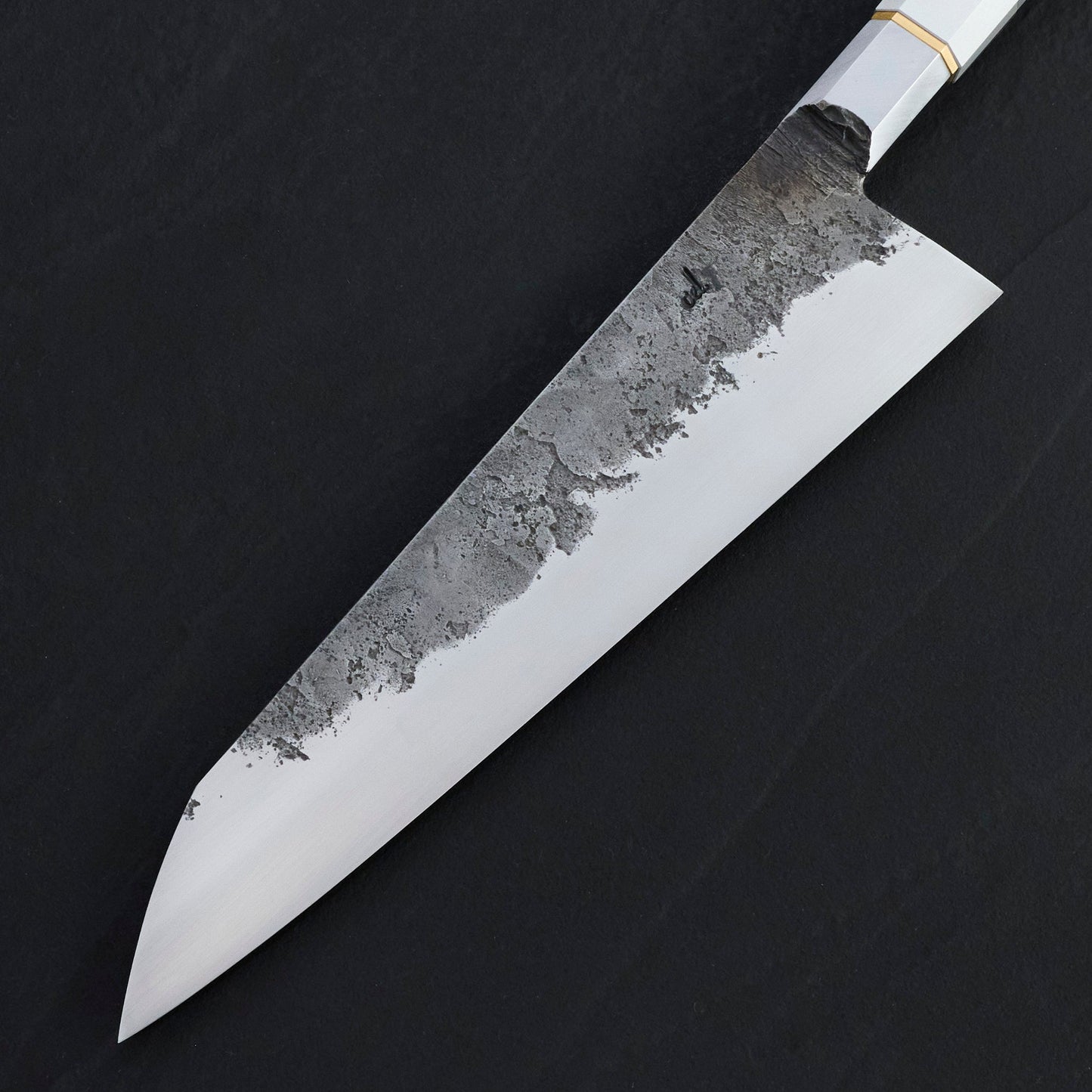
Gyuto 230mm Mono Integral Take Down
Gyuto 230mm Mono Integral Take Down
No longer available
Our Sydney workshop is closed until Monday 9 November. Orders placed now are very welcome and will ship in the order received from Tuesday 10 November. Shipping details
The 230mm Gyuto, forged from 1.3505 German Tool steel, represents the pinnacle of functional knife design by renowned German blacksmith Oliver Märtens of oel knives. Forged in his Kassel, Germany studio, this knife embodies Märtens’ signature design language, which is rooted in clean, deliberate lines and a focus on purpose-driven functionality. Influenced by the principles of the Bauhaus movement, Märtens integrates structural clarity and minimalist efficiency into every element of his work, ensuring that the form of the knife serves its practical role with precision.
The blade features a bold and performance-focused gyuto profile with wide convex bevels, providing an optimal balance between cutting power and precision. Its tapered spine enhances maneuverability, giving the knife a nimble and balanced feel in the hand. The ergonomic design ensures comfort and control, making it suitable for long hours of use in demanding kitchen environments. The focus on functionality and balance reflects Oliver’s commitment to creating tools that perform exceptionally well while feeling intuitive and responsive during use.
This Gyuto also showcases Oliver’s innovative take-down handle design, which allows for easy disassembly and maintenance without compromising structural integrity. You can learn more about this practical feature in this video on takedown handles. The handle itself combines a forged integral bolster with an anodized aluminum body and a custom brass rear end cap, secured with a titanium locking screw for durability. Märtens’ design philosophy is evident in every detail, delivering a knife that excels in cutting performance, ergonomic precision, and purposeful construction.
Product Specification
- Blade Type:
- Overall Length: 370mm
- Edge Length: 230mm
- Spine Heel: 3.9mm
- Spine Mid: 1.9mm
- Spine Tip (20mm before): 0.87mm
- Blade Height: 58mm
- Weight: 255g
- Cutting Edge Steel:
- Steel class: Carbon
- HRC: 65
- Blade Construction:
- Blade Finish: Textured, Satin Polish
- Grind:
- Handle Construction:
- Handle Materials: Anodised Aluminium, Brass
- Handedness: Ambidextrous
Shipping & Returns
Shipping & Returns
Shipping
We process orders Monday to Friday from our Sydney workshop. Australian orders are shipped with Australia Post and international orders with DHL Express. Shipping charges are calculated at checkout based on destination, shipment size and weight, and the carrier service available for the order.
Returns
If you're not entirely happy with your purchase, you can return it within 14 days of delivery for a refund. The item must be in its original condition with all original packaging.
- Returns are accepted for 14 days
- The customer is responsible for return shipping costs
- A 15% restocking fee may be applied to change-of-mind returns
- We do not accept returns on second-hand items for change of mind
Faulty or Damaged Items
You must notify us within 5 business days of receiving your order. Photographic evidence of damage is required. Once approved, Modern Cooking will cover return shipping costs.
Product Care
Product Care
Cleaning: Clean by hand with warm water. Avoid wetting the handle when possible.
Sharpening: We advise using whetstones to sharpen your knives and a honing rod or steel to maintain the burr between sharpening sessions.
Reactive Steels: Reactive steels like Aogami Super, Apex Ultra or premium reactive German and Swedish steels are susceptible to rust if not properly cared for. Keep the knife dry between uses and when storing for longer periods, wiping the blade with Tsubaki oil or another food-safe oil is a wise choice. A patina can be a beautiful personal feature on your knife and helps to stop rust forming.
Handle Care: For non-stabilised wooden handles, apply Tsubaki oil or another food-safe oil from time to time. Food-safe wax can be applied to both stabilised and non-stabilised wooden handles. Never apply hot wax or oil as you risk warping or damaging the handle.