Skip to product information
1 of 6

Chef Knife 200mm RWL-34 "Paragon Series" Japanese Pagoda

Chef Knife 200mm RWL-34 "Paragon Series" Japanese Pagoda

By Bernhard Noitz


Regular price Dhs. 3,512.00 AED
Regular price Sale price Dhs. 3,512.00 AED
Sale Sold out
Taxes included. Shipping calculated at checkout.

Low stock: 1 left

Quantity

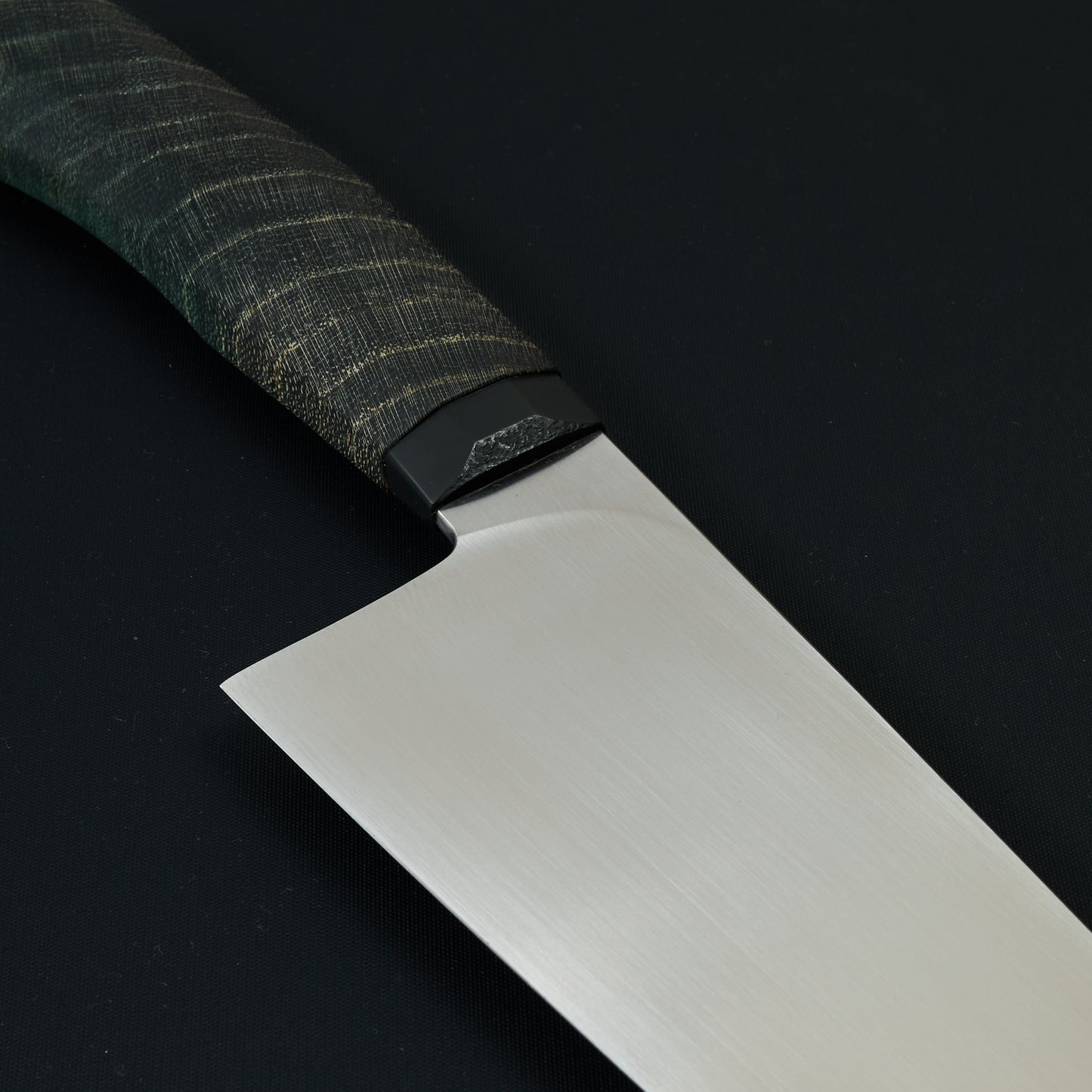
This Paragon Series chef knife is a singular, handcrafted expression of balance, versatility, and material refinement. Built around a contemporary European chef profile, the blade features a lightly tapered spine and a traditional edge curve that flows smoothly from heel to tip. A subtle increase in belly toward the front half of the blade provides relief for rocking motions and high-lift cuts, while the acute pointed tip excels at detail work and controlled entry cuts. The result is a knife that feels immediately intuitive, capable of covering the vast majority of kitchen tasks with ease and confidence.

The geometry is defined by wide convex bevels that promote clean separation and excellent food release across varied ingredients. This balanced grind avoids extremes, offering a composed feel that combines durability with finesse. Forged from premium RWL stainless steel, the blade delivers a fine, stable edge with strong wear resistance and minimal maintenance requirements. Heat treated to a measured hardness, it offers long-lasting performance while retaining a smooth, predictable sharpening response. A satin-polished finish underscores the knife’s precision and restraint, allowing the form and grind to speak for themselves.

The handle is executed in stabilised Japanese Pagoda wood, chosen for its distinctive structure and refined visual presence. Paired with a polished and textured paper micarta bolster, the handle provides strength, comfort, and balance. The ergonomically faceted western shape supports both pinch and hammer grips, giving the knife a secure, confident feel without excess bulk. Balanced, nimble, and quietly expressive, this Paragon Series knife embodies a modern approach to handcrafted kitchen cutlery—purposeful, refined, and entirely its own.

Product Specification
  • Blade Type:
  • Overall Length: 335mm
  • Edge Length: 200mm
  • Spine Heel: 3.25mm
  • Spine Mid: 2.5mm
  • Spine Tip (20mm before): 1.8mm
  • Blade Height: 58mm
  • Weight: 191.7g
  • Cutting Edge Steel:
  • Steel class: Stainless
  • HRC: 63
  • Blade Construction:
  • Blade Finish: Satin Polish
  • Grind:
  • Handle Construction:
  • Handle Materials: Stabilised Japanese Pagoda
  • Handedness: Ambidextrous

Blade type

Chef Knife

The Western chef's knife — the traditional European all-purpose blade, typically 200 to 250 mm, with a curved belly built to rock against the board. The pronounced curve from heel to tip suits a continuous rocking motion for mincing herbs and aromatics, and the blade is generally thicker, heavier, and softer than its Japanese counterpart, made to absorb hard and varied use.

That robustness is the trade-off. A Western chef's knife is forgiving, durable, and happy with bones, hard squash, and rough handling, but its softer steel and thicker grind mean it is rarely as keen as a comparable gyuto and needs more frequent honing to stay sharp. It is the dependable generalist of the kitchen — what it gives up in refinement it returns in resilience.

View full knife type guide →

Cutting edge steel

RWL34 / RWL

Powder metallurgy martensitic stainless tool steel

Typical HRC
60–63
Corrosion class
Stainless
Production
Powder
Origin
Sweden (Damasteel)

RWL34 — usually shortened to RWL — is Damasteel's powder-route stainless equivalent of ATS-34 / CPM-154, and is the bright-and-hard layer in much of the world's high-end stainless damascus. The composition (1.05 percent carbon, 14 percent chromium, 4 percent molybdenum, 0.2 percent vanadium) is essentially ATS-34 chemistry, but the rapid-solidification powder process produces a finer, cleaner microstructure than the conventional ingot route.

In a kitchen knife — usually a Damasteel-pattern blade — RWL34 runs at 60–62 HRC, sharpens cleanly, and produces a refined edge that holds well for the class. Edge retention is in the same band as SG2 at slightly lower hardness; toughness is good; corrosion resistance is excellent. The named association with Robert W. Loveless, the steel's original collaborator on the design, is half of the steel's mystique.

You see RWL most often as a mono-steel core in high-end custom work and as the contrast layer in Damasteel patterns. Among the makers Modern Cooking carries, Bernhard Noitz, Erik Gullikson, Evan Antzenberger, Jeroen Knippenberg, and Birch & Bevel work in RWL. It is a genuinely nice premium stainless that is somewhat under-discussed compared to the American powder steels.

View full steel guide →

Blade construction

Mono Steel

A knife forged from a single piece of steel — no laminations, no clad layers. The simplest and most direct construction. The entire blade is the cutting steel, with no softer outer jacket to protect or contrast it. Most contemporary Western kitchen knives in carbon and stainless steel are mono-steel constructions, as are honyaki and most European bladesmith work.

The trade-off is straightforward: mono-steel knives are easier to forge, sharpen, and reason about, but the entire blade carries the cutting steel's properties — including its reactivity if it's a clean carbon. There is no soft jacket to protect a more brittle core from impact, so the heat treatment and geometry have to do all the work.

View full construction guide →

Grind

Convex

A grind whose bevel bulges outward in a gentle curve from spine to edge, rather than running flat. That extra steel directly behind the edge makes a convex grind notably strong and resistant to chipping, while the curved geometry helps food release and lets the blade glide through dense ingredients with less wedging than a flat grind.

The strength comes at the cost of ultimate thinness and ease of maintenance. A convex edge has more metal behind it, so it is not quite as effortlessly keen as a thinly flat-ground edge, and it is harder to sharpen freehand — holding the curve takes a stropping technique or a deliberate hand rather than a single fixed angle. The reward is an exceptionally tough, smooth-cutting edge.

View full grind guide →

Handle construction

Hidden Tang

A construction in which the tang runs into the handle but stays concealed inside it, rather than showing between two scales. A narrower tang — a full-length stick or a shorter projection — is set into a drilled or burned channel in a one-piece handle and secured with adhesive, a friction fit, or a threaded fitting drawn up against the blade. This is the traditional construction of Japanese wa-handles and many European hidden-tang knives.

The design puts the handle material in charge of the look and feel: a single piece of wood, horn, or composite — often with a ferrule or spacers at the front — is shaped into any cross-section the maker wants, from the classic octagonal and D-shaped wa profiles to fully rounded Western forms. With no steel showing along the grip, the handle can be slim and light, and is frequently made to be removed and replaced, with the balance sitting toward the blade.

View full construction guide →

Shipping & Returns

Shipping

We process orders 5 days a week (Monday - Friday) and ship from our shop in Sydney, Australia. We ship with FedEx, UPS and DHL.

We are happy to offer free international shipping on a variety of orders depending on location and order value.

Free Shipping Regions and Minimum Order Values

For Australia and New Zealand the minimum is $500AUD. For the rest of the world it is approximately €1000EUR. The discount is applied automatically when you reach the minimum cart value at checkout.

Returns

If you're not entirely happy with your purchase, you can return it within 14 days of delivery for a refund. The item must be in its original condition with all original packaging.

  • Returns are accepted for 14 days
  • The customer is responsible for return shipping costs
  • A 15% restocking fee may be applied to change-of-mind returns
  • We do not accept returns on second-hand items for change of mind

Faulty or Damaged Items

You must notify us within 5 business days of receiving your order. Photographic evidence of damage is required. Once approved, Modern Cooking will cover return shipping costs.

Product Care

Cleaning: Clean by hand with warm water. Avoid wetting the handle when possible.

Sharpening: We advise using whetstones to sharpen your knives and a honing rod or steel to maintain the burr between sharpening sessions.

Reactive Steels: Reactive steels like Aogami Super, Apex Ultra or premium reactive German and Swedish steels are susceptible to rust if not properly cared for. Keep the knife dry between uses and when storing for longer periods, wiping the blade with Tsubaki oil or another food-safe oil is a wise choice. A patina can be a beautiful personal feature on your knife and helps to stop rust forming.

Handle Care: For non-stabilised wooden handles, apply Tsubaki oil or another food-safe oil from time to time. Food-safe wax can be applied to both stabilised and non-stabilised wooden handles. Never apply hot wax or oil as you risk warping or damaging the handle.

View full details