Skip to product information
1 of 6

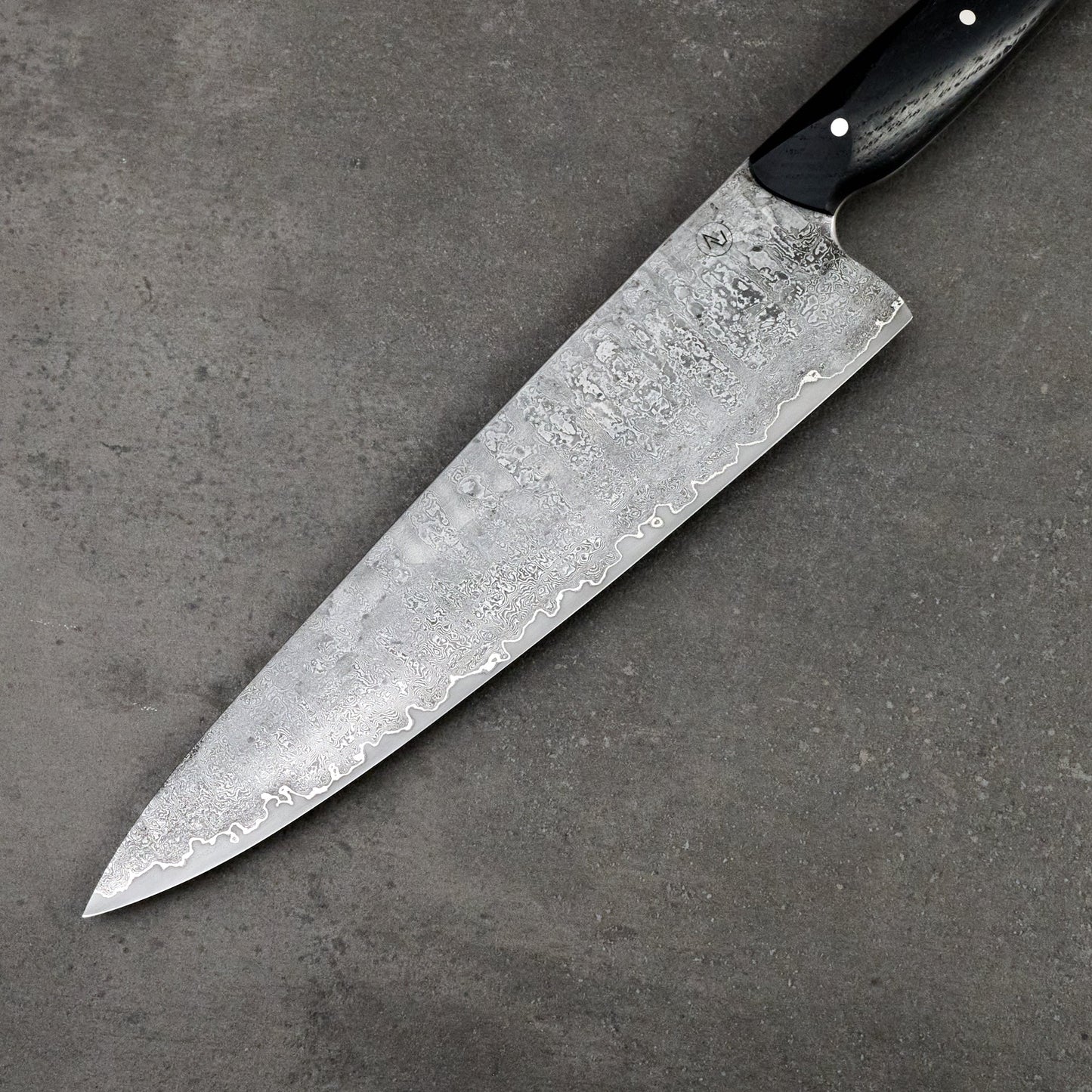
Gyuto 235mm Damascus and Apex Ultra GoMai

Gyuto 235mm Damascus and Apex Ultra GoMai

By Tobias Hangler


No longer available

Tobias Hangler

Reserve your place

We'll only email you when there's something to say. Invitations go out in signup order as new work becomes available.

Austrian metallurgist and blacksmith Tobias Hangler is continually perfecting his unique approach. After years of dedicated effort, the knives crafted by this Austrian artisan represent the culmination of extensive research and thousands of hours of refinement. Despite the intricate process of forging blades, Tobias has made it seem effortless through his meticulous work. Initially focusing on developing his own steel, perfecting heat treatments, and delving into knife geometry, Tobias has now shifted his attention to enhancing his distinctive style.

While traditional hidden tang designs remain prevalent, Tobias has always focused mainly on delivering finely tapered full tang handles. Crafted from exquisite, natural woods and shaped with his faceted, ergonomic design inspired by the contours of the human hand, these handles are tailored to fit snugly and comfortably, mirroring the natural grip of a closed fist. The Hangler handle boasts a form-fitting, comfortable design, with its two-way tapered geometry ensuring exceptional balance, imparting a sense of lightness and agility to his knives.

With a focus on practicality and performance, Tobias produces knives characterized by simple, elegant designs. This particular piece showcases a 120-layer Damascus cladding over his proprietary ApexUltra steel, featuring a GoMai construction with a nickel diffusion layer to preserve the integrity of the exceptionally tough ApexUltra steel. Combined with the Bog Oak handle, the result is a timeless, high-performance cutting tool that transcends trends.

Understated yet refined, this high-performance Gyuto knife epitomizes the kind of heirloom-quality tool that will endure for generations, much like the cherished tradition of family meals it will accompany, bringing joy to its fortunate owner throughout their lifetime.

Product Specification
  • Blade Type:
  • Edge Length: 235mm
  • Spine Heel: 3.81mm
  • Spine Mid: 2.12mm
  • Spine Tip (20mm before): 0.76mm
  • Blade Height: 57.24mm
  • Weight: 261g
  • Cutting Edge Steel:
  • Steel class: Carbon
  • HRC: 66
  • Blade Construction:
  • Blade Finish: Acid Etched (Forced Patina)Satin Polish
  • Grind:
  • Handle Construction:
  • Handle Materials: Bog Oak
  • Handedness: Ambidextrous

Blade type

Gyuto

牛刀

The Japanese take on the Western chef's knife, and the most versatile blade in a modern kitchen. A gyuto carries a long, gently curved edge — most often 210 to 270 mm — that allows both push cuts and a rocking motion, with a pointed tip for fine work and enough height at the heel to keep knuckles clear of the board. It handles proteins, vegetables, and herbs without complaint, which is why most cooks reach for it first.

Compared with a European chef's knife, the gyuto is usually thinner, harder, and lighter, ground to a finer edge that rewards good board technique and regular honing. That same thinness is the trade-off: the edge is less forgiving of bone, frozen food, and twisting cuts, and it asks for a little more care in maintenance in exchange for its keenness.

View full knife type guide →

Cutting edge steel

Apex Ultra

Low-alloy fine-grain carbon tool steel

Typical HRC
64–68
Corrosion class
Carbon
Production
Conventional
Origin
Austria (developed by Tobias Hangler and Marco Guldimann; project led by Hangler at Messerschmiede Hangler)

Apex Ultra is one of the most carefully engineered non-stainless kitchen knife steels in modern circulation, and the project of an Austrian smith — Tobias Hangler — who set out, with Marco Guldimann, to design a steel for the kitchen rather than borrow one from another industry. It carries roughly 1.25 percent carbon, around four percent chromium, modest tungsten and molybdenum, and a small vanadium addition. The composition is tuned to produce a fine, evenly distributed carbide structure that supports hardness up to 67 HRC while delivering toughness comparable to 52100 at the same hardness — a combination that is the entire point of the steel.

What this means for a cook is unusual permission. You can ask a maker to grind an Apex Ultra knife thin enough that a White #1 owner would call you brave, then ask for the heat treatment to land at 65 HRC, and the resulting edge will hold for longer than Aogami Super without microchipping. It sharpens cleanly on natural and synthetic stones alike and patinas slowly because of the chromium content, though it is not stainless and should be treated as a carbon steel.

Apex Ultra has become a signature steel of the European maker community, and the Modern Cooking catalogue carries an unusually deep bench of smiths working in it. Tobias Hangler himself heads that group, alongside Marco Guldimann, Benjamin Kamon, Martin Huber, Jonas Johnsson, Karol Karyś, Birch & Bevel, and MCx. It is genuinely a step forward — one of the relatively few cases where the marketing claims and the underlying metallurgical data are saying the same thing.

View full steel guide →

Blade construction

Laminated Steel

A category covering knives built from multiple layers of different steels forge-welded together. The hard cutting steel is sandwiched between softer outer layers (cladding) that protect the core, add toughness, and often contribute visual contrast.

The most common laminated constructions in the Modern Cooking catalogue are:

SanMai (三枚) — three layers: hard cutting steel in the centre, softer cladding on both sides. The traditional and most common form.

GoMai (五枚) — five layers: a hard core, two intermediate layers, and two outer layers. Adds visual depth and structural complexity.

KuMai (九枚) — nine layers: similar logic, with more cladding layers for additional pattern and structural variation.

GoMai and KuMai are often chosen not only for the additional layers and visual depth, but also because the intermediate layers can act as a nickel diffusion barrier — limiting carbon migration out of the core into the cladding during forge welding, and protecting the core's intended carbon content through the heat of the forging process.

In all cases the cutting performance is determined by the core steel; the outer layers are cosmetic and structural. The lamination contributes corrosion protection (when a stainless jacket clads a carbon core), reduced reactivity, and the visible boundary between core and cladding that gives the knife its character.

View full construction guide →

Grind

Walkschliff

A traditional Solingen grind — also called a kettle or kessel bulge grind — in which the blade is hollowed high on the side so its thickest point sits a little below the spine rather than at it. Below that bulge the steel is taken down to an extremely thin, finely convexed cutting edge, combining the rigidity of a thick upper blade with the keenness of a very thin one.

The Walkschliff is among the most demanding grinds to execute, historically reserved for the finest German knives and requiring years of a grinder's experience to do well. For the buyer it is a high-craft European alternative to the thin flat grinds of Japanese knives — strong, stable, and keen — but it is a hand-ground specialism, and a knife that carries it is priced for the skill it took to make.

View full grind guide →

Handle construction

Full Tang

A construction in which the blade steel runs the full length and width of the handle, forming a flat core between two handle scales. The scales are fixed to either face of the tang with pins, rivets, or adhesive, and the tang's outline stays visible as a strip of steel around the top, bottom, and butt of the handle — often with the pin heads showing as a row down each side. It is the dominant construction in Western kitchen and outdoor knives.

Because the steel continues all the way to the butt, the handle is essentially the tang dressed in two scales, and the grip is ground and shaped from that sandwiched assembly as a whole. The extra steel carries weight and balance back toward the hand, giving the solid, blade-and-handle-as-one feel that defines the style, and it leaves the edge of the tang on show as part of the knife's line.

View full construction guide →

Shipping & Returns

Shipping

We process orders 5 days a week (Monday - Friday) and ship from our shop in Sydney, Australia. We ship with FedEx, UPS and DHL.

We are happy to offer free international shipping on a variety of orders depending on location and order value.

Free Shipping Regions and Minimum Order Values

For Australia and New Zealand the minimum is $500AUD. For the rest of the world it is approximately €1000EUR. The discount is applied automatically when you reach the minimum cart value at checkout.

Returns

If you're not entirely happy with your purchase, you can return it within 14 days of delivery for a refund. The item must be in its original condition with all original packaging.

  • Returns are accepted for 14 days
  • The customer is responsible for return shipping costs
  • A 15% restocking fee may be applied to change-of-mind returns
  • We do not accept returns on second-hand items for change of mind

Faulty or Damaged Items

You must notify us within 5 business days of receiving your order. Photographic evidence of damage is required. Once approved, Modern Cooking will cover return shipping costs.

Product Care

Cleaning: Clean by hand with warm water. Avoid wetting the handle when possible.

Sharpening: We advise using whetstones to sharpen your knives and a honing rod or steel to maintain the burr between sharpening sessions.

Reactive Steels: Reactive steels like Aogami Super, Apex Ultra or premium reactive German and Swedish steels are susceptible to rust if not properly cared for. Keep the knife dry between uses and when storing for longer periods, wiping the blade with Tsubaki oil or another food-safe oil is a wise choice. A patina can be a beautiful personal feature on your knife and helps to stop rust forming.

Handle Care: For non-stabilised wooden handles, apply Tsubaki oil or another food-safe oil from time to time. Food-safe wax can be applied to both stabilised and non-stabilised wooden handles. Never apply hot wax or oil as you risk warping or damaging the handle.

View full details