Skip to product information
1 of 6

Sujihiki 305mm Damasteel & Koa

Sujihiki 305mm Damasteel & Koa

By Martin Huber


Regular price 13,484.00 SEK
Regular price Sale price 13,484.00 SEK
Sale Sold out
Taxes included. Shipping calculated at checkout.

Low stock: 1 left

Quantity

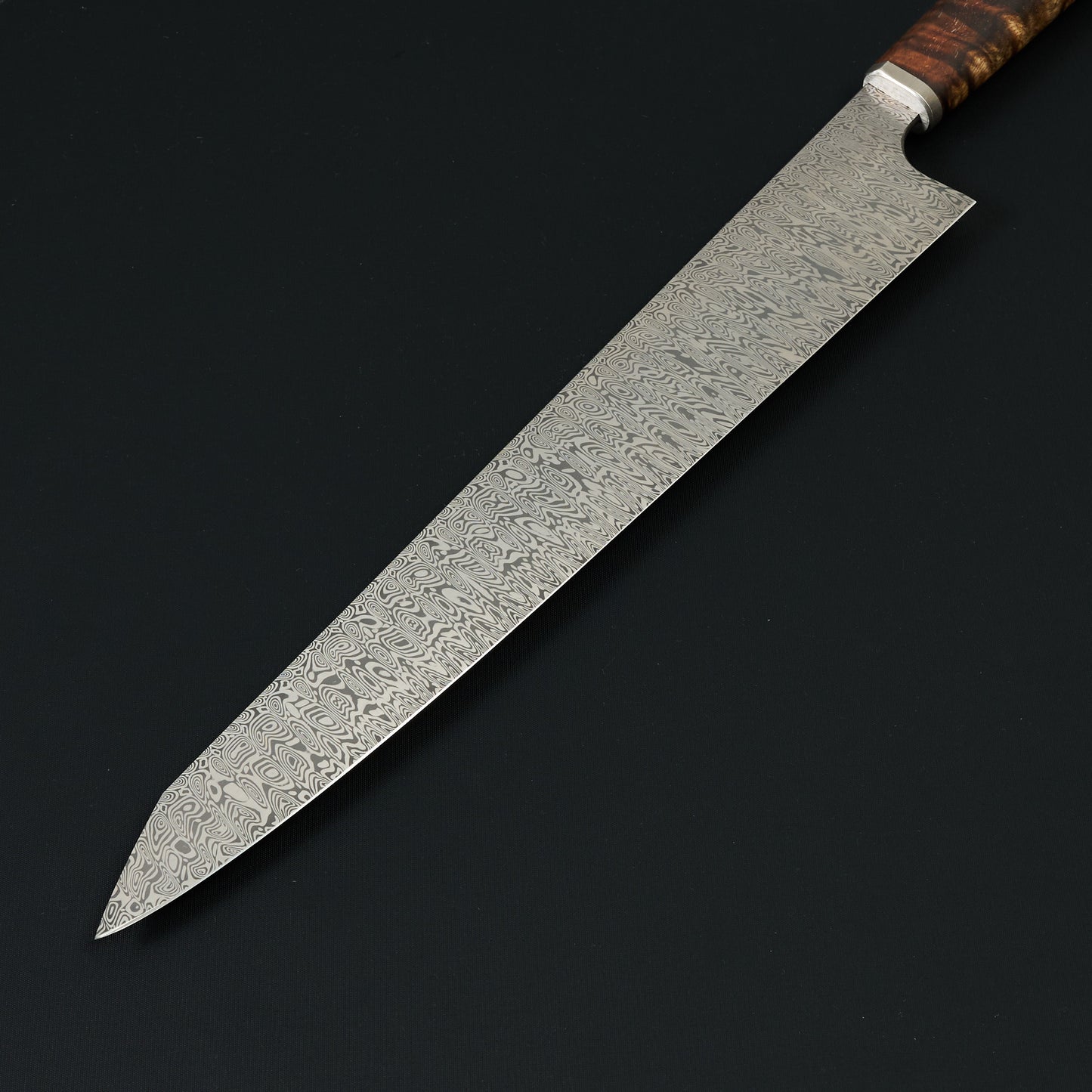
This one-of-a-kind Sujihiki is the work of Martin Huber and his small team in Garsten, Austria, makers known for a restrained, geometry-led approach and meticulous finish. A 305mm slicer is a specialist: the long, low blade is built to part cooked and raw proteins in a single smooth draw, carving roasts and portioning fish with clean faces and little sawing. At just 47.83mm tall it tracks straight and true through the cut, sitting alongside a chef's knife rather than replacing it.

The spine tapers sharply from 3.35mm at the heel through 1.51mm at mid-blade to a remarkably fine 0.32mm near the tip, giving the front of the blade an almost delicate agility while the rear stays rigid. The edge is shaped by a walkschliff grind — the demanding Solingen kettle grind that hollows the blade high on the side and takes the steel down to an ultra-thin, finely convex edge, marrying the rigidity of a thick upper blade to the keenness of a very thin one. The Damasteel is acid-etched to draw out its damascus pattern, then settled under a satin polish that lends depth without pulling focus from the blade.

Damasteel is a Swedish powder-metallurgy stainless damascus — two fine powder steels pattern-welded for the figure, but, once forged, behaving as one unified blade rather than a laminated core and jacket. Hardened to 63 HRC, it takes a refined edge, holds it respectably, and offers the easy corrosion resistance of a true stainless — a slicer you can carry to fish and citrus without a second thought. The handle is a hidden-tang construction in figured koa with stainless steel fittings, the concealed tang letting the wood carry the look while the balance sits forward toward the blade for control through the draw.

The result is a dedicated slicer that pairs one of Europe's most demanding grinds with an expressive stainless damascus: high craft in a form made to earn its place on the board. It is a one-off from Martin's Garsten workshop — a maker we are proud to carry — and made to be kept.

Product Specification
  • Blade Type:
  • Overall Length: 450mm
  • Edge Length: 305mm
  • Spine Heel: 3.35mm
  • Spine Mid: 1.51mm
  • Spine Tip (20mm before): 0.32mm
  • Blade Height: 47.83mm
  • Weight: 206.3g
  • Cutting Edge Steel:
  • Steel class: Stainless
  • HRC: 63
  • Blade Construction:
  • Blade Finish: Acid Etched (Forced Patina), Satin Polish
  • Grind:
  • Handle Construction:
  • Handle Materials: Koa, Stainless Steel
  • Handedness: Ambidextrous

Blade type

Sujihiki

筋引

A long, slender slicing knife — typically 240 to 300 mm — and the Japanese equivalent of a Western carving knife. The narrow blade and long, straight edge are built to part cooked and raw proteins in a single smooth draw, producing clean slices with minimal sawing and minimal tearing of the surface. Height is kept low so the blade tracks straight through the cut.

A sujihiki is a specialist, and a worthwhile one for anyone who carves roasts, portions fish, or slices proteins regularly. Its length and narrowness make it poor for general board work and chopping, so it lives alongside a chef's knife rather than instead of one. The reward for that dedicated slot is slices a shorter, taller knife simply cannot match.

View full knife type guide →

Cutting edge steel

Damasteel

Brand / process — powder metallurgy stainless damascus

Typical HRC
60–63
Corrosion class
Stainless
Production
Pattern-welded
Origin
Sweden

Damasteel is not a single steel but the brand and process of a Swedish manufacturer producing pattern-welded stainless damascus from powder-metallurgy steels — most commonly RWL34 paired with PMC27 (a softer stainless contrast layer). The two powders are layered, hot isostatic pressed, and forge-welded into patterned billets with names like Odin's Eye, Vinland, Hakkapella and Thor.

In a kitchen knife built from Damasteel the metallurgy is governed by the harder layer (typically RWL34); the softer layer is cosmetic. Hardness in the low sixties is typical, and the cutting behaviour is for practical purposes that of a RWL34 blade — a refined, stainless powder edge with very good corrosion resistance and respectable edge retention.

You see Damasteel most often in high-end custom folders and in display-grade kitchen knives where pattern is part of the brief. Among the makers Modern Cooking carries, Fredrik Spåre, Martin Huber, Jonas Johnsson, and MCx work in Damasteel. It is the gold standard for visually expressive stainless damascus and a reliable indicator that the maker is comfortable working at the upper end of the steel-supply chain.

View full steel guide →

Blade construction

Mono Steel

A knife forged from a single piece of steel — no laminations, no clad layers. The simplest and most direct construction. The entire blade is the cutting steel, with no softer outer jacket to protect or contrast it. Most contemporary Western kitchen knives in carbon and stainless steel are mono-steel constructions, as are honyaki and most European bladesmith work.

The trade-off is straightforward: mono-steel knives are easier to forge, sharpen, and reason about, but the entire blade carries the cutting steel's properties — including its reactivity if it's a clean carbon. There is no soft jacket to protect a more brittle core from impact, so the heat treatment and geometry have to do all the work.

View full construction guide →

Grind

Walkschliff

A traditional Solingen grind — also called a kettle or kessel bulge grind — in which the blade is hollowed high on the side so its thickest point sits a little below the spine rather than at it. Below that bulge the steel is taken down to an extremely thin, finely convexed cutting edge, combining the rigidity of a thick upper blade with the keenness of a very thin one.

The Walkschliff is among the most demanding grinds to execute, historically reserved for the finest German knives and requiring years of a grinder's experience to do well. For the buyer it is a high-craft European alternative to the thin flat grinds of Japanese knives — strong, stable, and keen — but it is a hand-ground specialism, and a knife that carries it is priced for the skill it took to make.

View full grind guide →

Handle construction

Hidden Tang

A construction in which the tang runs into the handle but stays concealed inside it, rather than showing between two scales. A narrower tang — a full-length stick or a shorter projection — is set into a drilled or burned channel in a one-piece handle and secured with adhesive, a friction fit, or a threaded fitting drawn up against the blade. This is the traditional construction of Japanese wa-handles and many European hidden-tang knives.

The design puts the handle material in charge of the look and feel: a single piece of wood, horn, or composite — often with a ferrule or spacers at the front — is shaped into any cross-section the maker wants, from the classic octagonal and D-shaped wa profiles to fully rounded Western forms. With no steel showing along the grip, the handle can be slim and light, and is frequently made to be removed and replaced, with the balance sitting toward the blade.

View full construction guide →

Shipping & Returns

Shipping

We process orders 5 days a week (Monday - Friday) and ship from our shop in Sydney, Australia. We ship with FedEx, UPS and DHL.

We are happy to offer free international shipping on a variety of orders depending on location and order value.

Free Shipping Regions and Minimum Order Values

For Australia and New Zealand the minimum is $500AUD. For the rest of the world it is approximately €1000EUR. The discount is applied automatically when you reach the minimum cart value at checkout.

Returns

If you're not entirely happy with your purchase, you can return it within 14 days of delivery for a refund. The item must be in its original condition with all original packaging.

  • Returns are accepted for 14 days
  • The customer is responsible for return shipping costs
  • A 15% restocking fee may be applied to change-of-mind returns
  • We do not accept returns on second-hand items for change of mind

Faulty or Damaged Items

You must notify us within 5 business days of receiving your order. Photographic evidence of damage is required. Once approved, Modern Cooking will cover return shipping costs.

Product Care

Cleaning: Clean by hand with warm water. Avoid wetting the handle when possible.

Sharpening: We advise using whetstones to sharpen your knives and a honing rod or steel to maintain the burr between sharpening sessions.

Reactive Steels: Reactive steels like Aogami Super, Apex Ultra or premium reactive German and Swedish steels are susceptible to rust if not properly cared for. Keep the knife dry between uses and when storing for longer periods, wiping the blade with Tsubaki oil or another food-safe oil is a wise choice. A patina can be a beautiful personal feature on your knife and helps to stop rust forming.

Handle Care: For non-stabilised wooden handles, apply Tsubaki oil or another food-safe oil from time to time. Food-safe wax can be applied to both stabilised and non-stabilised wooden handles. Never apply hot wax or oil as you risk warping or damaging the handle.

View full details