Skip to product information
1 of 11

Santoku 210mm Takedown By Benjamin Kamon & Oliver Märtens

Santoku 210mm Takedown By Benjamin Kamon & Oliver Märtens

By MCx


Regular price 17.928,00 RON
Regular price Sale price 17.928,00 RON
Sale Sold out
Taxes included. Shipping calculated at checkout.

Low stock: 1 left

Quantity

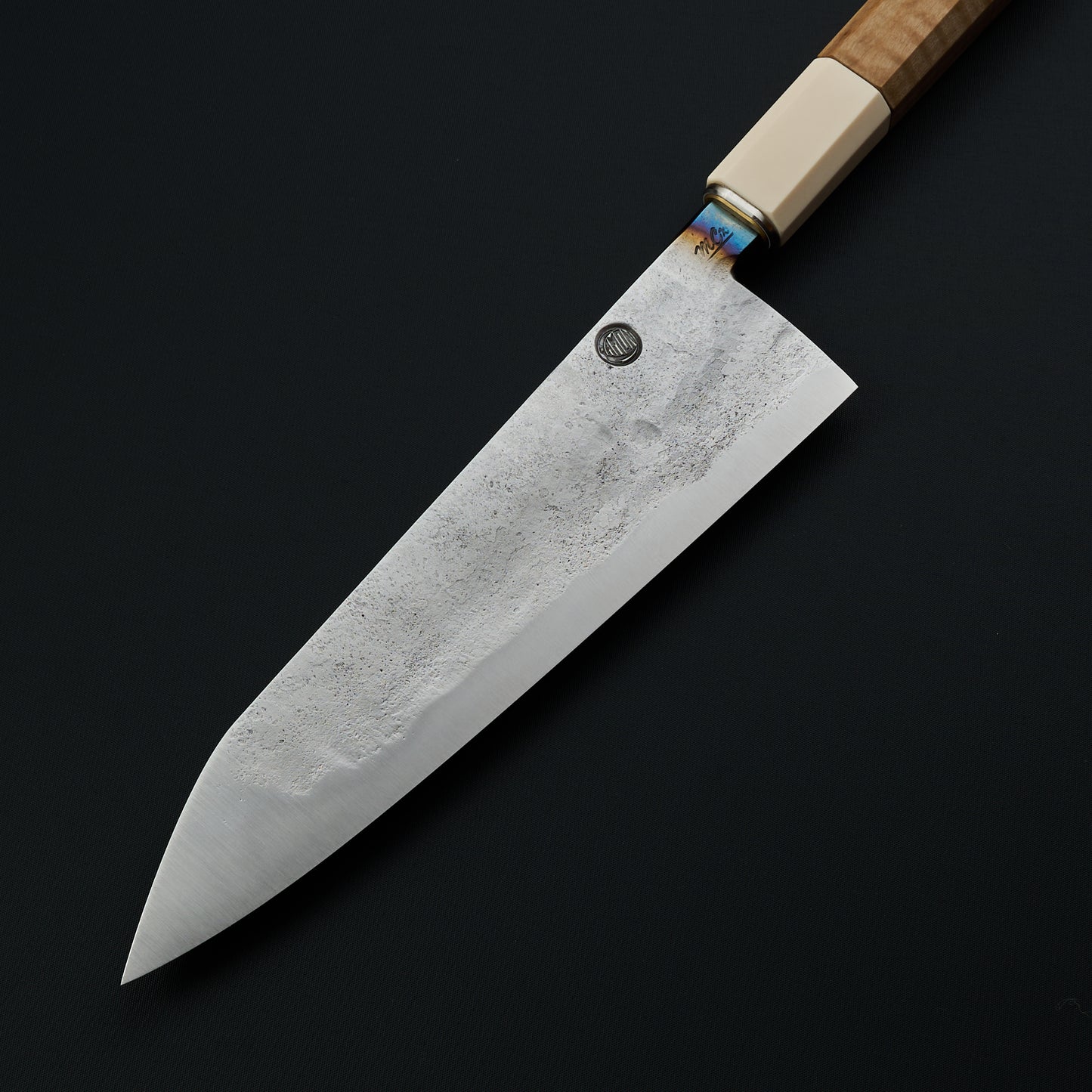
Edition 03 of the MCx Kamon × Märtens line is a Santoku, and the first release in the collaboration to move away from the Gyuto. The blade is forged and ground by Benjamin Kamon in Vienna, the handle built by Oliver Märtens in Kassel, and it features Kamon's own Santoku profile — larger than the classic Japanese Santoku, and unmistakably his. Where the first two editions were dark, classic and deliberately bold, Edition 03 moves the other way: lighter in colour, lighter in the hand and quicker on the board, with the same obsession over performance and build quality that defines the line.

An aggressive distal taper gives the knife a finely balanced feel — rigid and powerful at the heel, fine and deft at the tip — and Kamon's low convex bevels carry it through ingredients with little drag and excellent food release, for an effortless cutting experience. The blade is forged from 1.2519, the German tungsten-chromium tool steel Kamon has worked for years, and his heat treatment takes it to 65 HRC, for a keen edge that holds through months of heavy use. Above the bevels the nashiji texture is taken to a high satin polish, pale and quietly reflective, while below it the belt-finished bevels carry a fine and perfectly even scratch pattern from heel to tip. Hues of blue and red, the result of flame tempering around the neck, give the knife a singular pop of colour that lifts an otherwise light and subtle design.

The handle is Märtens' intricate takedown design, an octagon built from seven hand-made parts, each one precision milled, turned or ground, and finished with the array of techniques that has made his handle work quietly recognisable among collectors. The facets, delightfully relieved, give the handle an ergonomic and comfortable feel and index in the hand without thought, lending the blade a precision feel like no other. Maple and chestnut were chosen piece by piece, since no single timber met the standard across the whole batch, then matched so that every knife in the edition reads as one of a set. Stainless end caps with inlaid brass accents close the handle at both ends, with an Elforyn Super Tusk ferrule set behind the front cap, and the whole assembly is drawn together by a single hex key fastening through the rear cap, so the handle comes away cleanly for maintenance and sharpening.

The same three minds, and a completely different feel. Edition 03 is made in small numbers, and like everything in the MCx Kamon × Märtens line it is built around performance first, with beauty following as its natural consequence. We are very proud of this release and delighted to be able to offer you these exceptional culinary tools.

Product Specification
  • Blade Type:
  • Overall Length: 350mm
  • Edge Length: 210mm
  • Spine Heel: 6.17mm
  • Spine Mid: 1.65mm
  • Spine Tip (20mm before): 0.6mm
  • Blade Height: 56.9mm
  • Weight: 220g
  • Cutting Edge Steel:
  • Steel class: Carbon
  • HRC: 65
  • Blade Construction:
  • Blade Finish: Textured, Satin Polish, Tempered
  • Grind:
  • Handle Construction:
  • Handle Materials: Maple, Chestnut, Brass, Stainless Steel, Elforyn® Super Tusk
  • Handedness: Ambidextrous

Blade type

Santoku

三徳

A shorter, lighter all-purpose knife — usually 165 to 180 mm — built around the same "three virtues" the name describes: meat, fish, and vegetables. The edge is flatter than a gyuto's, with a rounded, sheepsfoot-style tip, favouring a straight up-and-down push cut over a rocking motion. Its compact length and modest height make it easy to control, which has made it the default home-kitchen knife across much of the world.

The santoku trades reach and tip precision for manageability. The flatter profile and shorter blade suit smaller hands, smaller boards, and cooks who chop rather than rock, but those same dimensions limit it on large proteins and tall vegetables where a longer, taller blade does the work more easily. Think of it as a gyuto's more approachable counterpart rather than a replacement.

View full knife type guide →

Cutting edge steel

1.2519

Low-alloy tungsten-chromium tool steel

Typical HRC
62–65
Corrosion class
Carbon
Production
Conventional
Origin
Germany (DIN 110WCrV5)

1.2519 is the classic German oil-hardening Cr-W-V tool steel — close kin to AISI O7 and a sister to 1.2419, with a touch more vanadium for finer carbides. The tungsten and chromium combine to produce hard, finely dispersed carbides that allow a thin geometry to hold an edge longer than the simple carbons, while the vanadium keeps grain size tidy through the heat treat.

In a kitchen knife, it lands comfortably between 62 and 64 HRC and behaves like a slightly more wear-resistant W2 — that is, it sharpens with little fuss on most stones, takes a fine edge, and rewards a deliberate heat treatment more than it punishes a casual one. It will patina, sometimes attractively, sometimes alarmingly to a first-time carbon owner; either way, a wipe-and-dry habit is enough to keep it civil.

You will find 1.2519 in the work of European bladesmiths who want a step up in edge retention from white-paper carbons without losing the easy stone feel. Among the makers Modern Cooking carries, Benjamin Kamon, Martin Huber, Tobias Heldqvist, Jonas Johnsson, and MCx work in 1.2519. It is one of the more honest "European answers to Aogami" — not the same metallurgy, but a similar relationship between feel at the stone and edge longevity.

View full steel guide →

Blade construction

Mono Steel

A knife forged from a single piece of steel — no laminations, no clad layers. The simplest and most direct construction. The entire blade is the cutting steel, with no softer outer jacket to protect or contrast it. Most contemporary Western kitchen knives in carbon and stainless steel are mono-steel constructions, as are honyaki and most European bladesmith work.

The trade-off is straightforward: mono-steel knives are easier to forge, sharpen, and reason about, but the entire blade carries the cutting steel's properties — including its reactivity if it's a clean carbon. There is no soft jacket to protect a more brittle core from impact, so the heat treatment and geometry have to do all the work.

View full construction guide →

Grind

Convex

A grind whose faces curve outward in a continuous arc rather than falling in a straight line. The practical consequence is that it has no shoulder — no abrupt step where a bevel meets the blade face. Food release improves for the same reason: a curved face touches the cut surface along a narrow band instead of a full flat plane, so slices break away rather than clinging. Drag behaves differently too. A convex blade carries more steel than a flat grind of the same spine thickness, so it is not the lowest-drag geometry available, but the resistance it does create builds smoothly through the cut instead of arriving all at once as the food meets a bevel transition. The feel is progressive rather than sudden.

The curve also supports the edge. Steel thickens quickly behind the apex, which raises edge stability at a given sharpening angle — the apex is less prone to rolling or chipping under lateral load. How much of that you get depends on where the convexity sits. A face can be curved the whole way from spine to edge, or the curve can be confined to the last millimetre or two as a convex "appleseed" edge on an otherwise flat blade. The first shapes how the knife moves through food; the second is felt almost entirely at the edge.

View full grind guide →

Handle construction

Takedown

A takedown is a hidden-tang construction built to come apart. The tang passes through the handle and is drawn up by a threaded fitting — a nut at the butt, or a pommel that screws down — so the handle can be dismantled and re-fitted rather than being permanently bonded in place. Everything else follows the hidden-tang pattern: a concealed tang inside a one-piece handle, with no steel showing along the grip.

The point of the design is serviceability. Because the handle is mechanical rather than glued, it can be taken off for thorough cleaning and drying, swapped for a different material or profile, or replaced entirely if it is ever damaged — all without destroying the original fittings. It is the construction to choose for a knife meant to be maintained and kept for the long term, and for owners who like the option of changing a handle later.

View full construction guide →

Shipping & Returns

Shipping

We process orders 5 days a week (Monday - Friday) and ship from our shop in Sydney, Australia. We ship with FedEx, UPS and DHL.

We are happy to offer free international shipping on a variety of orders depending on location and order value.

Free Shipping Regions and Minimum Order Values

For Australia and New Zealand the minimum is $500AUD. For the rest of the world it is approximately €1000EUR. The discount is applied automatically when you reach the minimum cart value at checkout.

Returns

If you're not entirely happy with your purchase, you can return it within 14 days of delivery for a refund. The item must be in its original condition with all original packaging.

  • Returns are accepted for 14 days
  • The customer is responsible for return shipping costs
  • A 15% restocking fee may be applied to change-of-mind returns
  • We do not accept returns on second-hand items for change of mind

Faulty or Damaged Items

You must notify us within 5 business days of receiving your order. Photographic evidence of damage is required. Once approved, Modern Cooking will cover return shipping costs.

Product Care

Cleaning: Clean by hand with warm water. Avoid wetting the handle when possible.

Sharpening: We advise using whetstones to sharpen your knives and a honing rod or steel to maintain the burr between sharpening sessions.

Reactive Steels: Reactive steels like Aogami Super, Apex Ultra or premium reactive German and Swedish steels are susceptible to rust if not properly cared for. Keep the knife dry between uses and when storing for longer periods, wiping the blade with Tsubaki oil or another food-safe oil is a wise choice. A patina can be a beautiful personal feature on your knife and helps to stop rust forming.

Handle Care: For non-stabilised wooden handles, apply Tsubaki oil or another food-safe oil from time to time. Food-safe wax can be applied to both stabilised and non-stabilised wooden handles. Never apply hot wax or oil as you risk warping or damaging the handle.

View full details