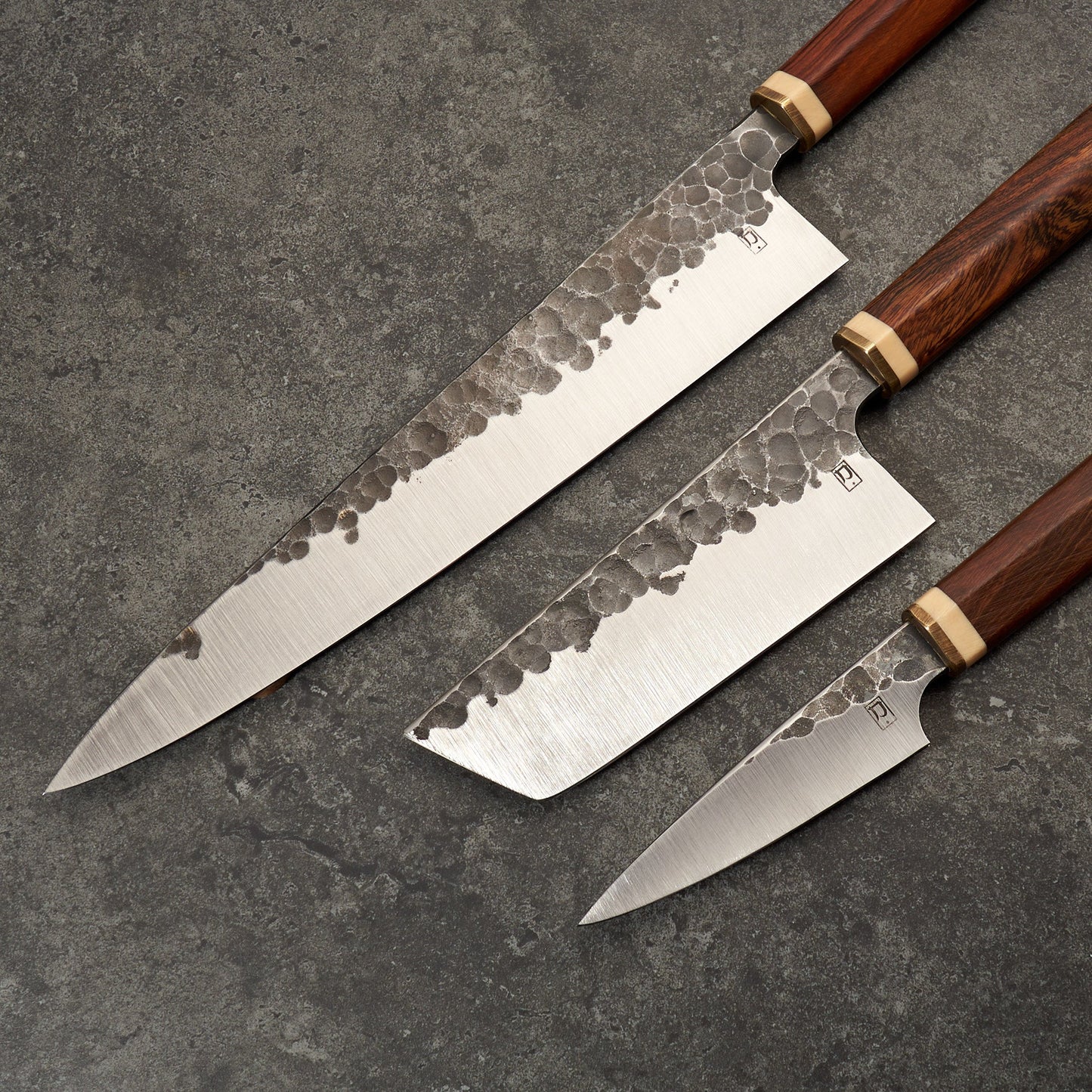
Wabi Sabi Kitchen Knife Set
Wabi Sabi Kitchen Knife Set
By Jim Dobbler
No longer available
Our Sydney workshop is closed until Monday 9 November. Orders placed now are very welcome and will ship in the order received from Tuesday 10 November. Shipping details
The Wabi Sabi Kitchen knife set from American master craftsman Jim Dobbler is a selection of some of the most useful knives in the cook’s armoury and in very complimentary sizes. This Gyuto, Nakiri, and Petty set complete with Piotr the Bear wall magnet is the ultimate kitchen knife starter kit.
At the heart of the set is a versatile 265mm Gyuto with a sleek and classy profile with a rigid tapered spine. At the edge the knife is about 25% flat, with a lovely belly that ends in a tight curve before the tip. The blade feels very comfortable on the board with a satisfying weight and balance. The profile lends itself well to push/pull cuts and will rock comfortably for those rock choppers. Balanced for a pinch grip, equilibrium can be found at the “Dobbler Made” mark.
In addition to the Gyuto is a 130mm Nakiri vegetable knife. The profile, paying homage to its Usuba heritage, is very flat with a slight curve just before the end of the blade. At 130mm the blade feels nimble and agile, comfortable working with produce in hand or on the board. The edge is super thin and feels razor sharp perfect for detailed vegetable prep.
Rounding out the set is a 100mm Petty. Next to the Gyuto its one of the most versatile prep knives and makes for a perfect addition to this set. A pointed profile with a similar profile to the Gyuto is found here. It’s a great little knife for hand work and detailed trimming.
The blades are all forged in AEB-L stainless steel, a very quality steel with great edge retention and hardness (64HRC). The blades are all hollow ground to varying degrees, the Gyuto for example is a very subtly hollow ground, while the Petty and the Nakiri are more pronounced as suited to their individual purposes. This hollow ground geometry give the blades a very sharp edge and great performance with regard to slicing.
The handles are made from a combination of Arizona Ironwood, imitation ivory and patinated brass. The combination is stunning!
Fit and finish on these blades is of the highest standard and when paired with the ultra-premium 30cm Piotr the Bear wall mounted kitchen knife magnet in American Walnut you have the ultimate kitchen knife set.
Included:
- Jim Dobbler Gyuto 265mm AEB-l Wabi Sabi Series
- Jim Dobbler Nakiri 130mm AEB-l Wabi Sabi Series
- Jim Dobbler Petty 100mm AEB-l Wabi Sabi Series
- Piotr the Bear 30cm wall mounted kitchen knife magnet American Walnut
Product Specification
- Blade Type:
- Edge Length: 265mm | 130mm | 100mm
- Spine Heel: 3.2mm | 3.2mm | 3.2mm
- Spine Mid: 2.8mm | 2.9mm | 3mm
- Spine Tip (20mm before): 1.5mm | 2.8mm | 1.4mm
- Blade Height: 53mm | 53.5mm | 28mm
- Weight: 2.35g | 1.94g | 90g
- Cutting Edge Steel:
- Steel class: Carbon
- HRC: 64+
- Blade Construction:
- Blade Finish: Textured, Kurouchi
- Grind:
- Handle Construction:
- Handle Materials: Arizona Ironwood, Imitation Ivory and patinated brass
- Handedness: Ambidextrous
Shipping & Returns
Shipping & Returns
Shipping
We process orders Monday to Friday from our Sydney workshop. Australian orders are shipped with Australia Post and international orders with DHL Express. Shipping charges are calculated at checkout based on destination, shipment size and weight, and the carrier service available for the order.
Returns
If you're not entirely happy with your purchase, you can return it within 14 days of delivery for a refund. The item must be in its original condition with all original packaging.
- Returns are accepted for 14 days
- The customer is responsible for return shipping costs
- A 15% restocking fee may be applied to change-of-mind returns
- We do not accept returns on second-hand items for change of mind
Faulty or Damaged Items
You must notify us within 5 business days of receiving your order. Photographic evidence of damage is required. Once approved, Modern Cooking will cover return shipping costs.
Product Care
Product Care
Cleaning: Clean by hand with warm water. Avoid wetting the handle when possible.
Sharpening: We advise using whetstones to sharpen your knives and a honing rod or steel to maintain the burr between sharpening sessions.
Reactive Steels: Reactive steels like Aogami Super, Apex Ultra or premium reactive German and Swedish steels are susceptible to rust if not properly cared for. Keep the knife dry between uses and when storing for longer periods, wiping the blade with Tsubaki oil or another food-safe oil is a wise choice. A patina can be a beautiful personal feature on your knife and helps to stop rust forming.
Handle Care: For non-stabilised wooden handles, apply Tsubaki oil or another food-safe oil from time to time. Food-safe wax can be applied to both stabilised and non-stabilised wooden handles. Never apply hot wax or oil as you risk warping or damaging the handle.