Skip to product information
1 of 5

Gyuto 220mm W2 Honyaki Water Quenched

Gyuto 220mm W2 Honyaki Water Quenched

By PRE-OWNED


Regular price CHF 1,744.00
Regular price Sale price CHF 1,744.00
Sale Sold out
Taxes included. Shipping calculated at checkout.

Out of stock

Quantity

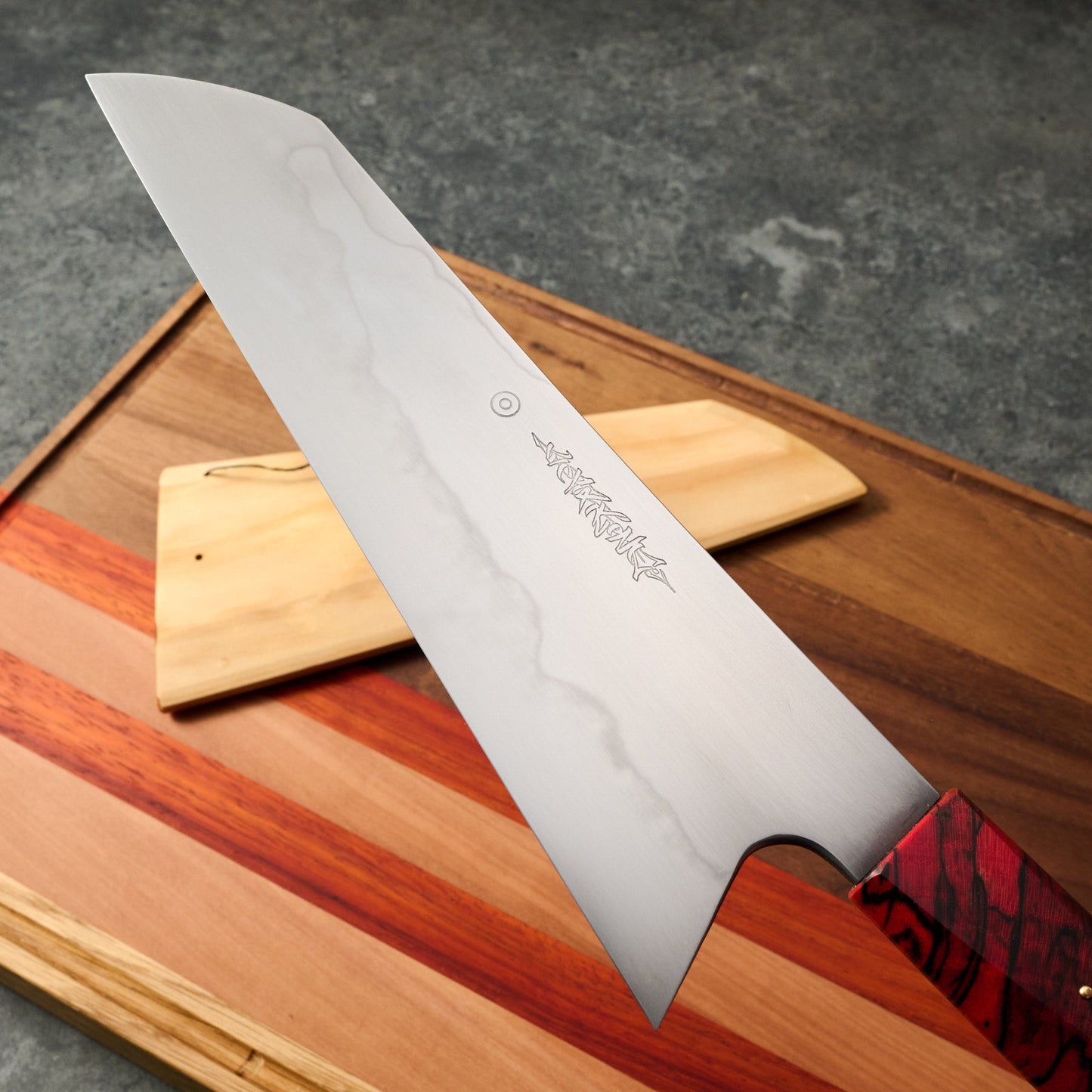
A stunning water quenched honyaki blade from Australian artisan craftsman James Oatley. Forged in W2 steel the blade has been precision ground with a thin tapered, walkschliff grind and James’s iconic santoku tipped gyuto profile. Designed for stability the blade has a nimble light weight and well balance feel about it. Every edge and curve has been painstakingly smoothed over to give the blade a delightfully luxurious feel about it.

The stunning hamon features beautiful ashi clouds and well-defined lines giving this stunning blade a 100% unique characteristic. Paired with an incredibly rare, stabilized hackberry handle with a brass fastening pin.

The knife comes with hand crafted saya in Mayple and is finished with James's signature iconography including the Australian convict arrow,  and Oatley O. A beautiful piece of work from James Oatley.

This knife was never actually sold, but it was refinished in store due to a small blemish on the original etch. For this reason we have reduced the price and are offering it as Pre-Owned.

Condition: New, Never Used

Product Specification
  • Blade Type:
  • Edge Length: 220mm
  • Spine Heel: 2.96mm
  • Spine Mid: 1.75mm
  • Spine Tip (20mm before): 1mm
  • Blade Height: 61mm
  • Weight: 226g
  • Cutting Edge Steel:
  • Steel class: Carbon
  • HRC: 63
  • Blade Construction:
  • Blade Finish: Satin Polish
  • Grind:
  • Handle Construction:
  • Handle Materials: Stabilised Hackberry
  • Handedness: Ambidextrous
  • Saya / Storage Included: Yes

Blade type

Gyuto

牛刀

The gyuto is the Japanese interpretation of the western chef knife, and the most versatile blade in a modern kitchen. It carries a long edge, most often 210 to 270 mm, that runs flatter through the heel than its western counterpart before rising in a gentle, late curve to a fine point — a line that favours push- and pull-cutting while still allowing a rocking motion when the work calls for it. There is enough height at the heel to keep knuckles clear of the board, and the tip is fine enough for detail work, which is why most cooks reach for it first.

The flatter edge is the defining characteristic and the trade-off both. More of the blade lands on the board at once, which suits push cutting and gives clean, decisive contact through an ingredient, but a cook who works primarily by rocking will find less curve to work with than a western profile offers. Modern makers increasingly blur the line between the two, drawing a profile that rocks and push-cuts equally well — Birch & Bevel's Modern Gyuto profile, Antoine Kniamen's Western Gyuto, and Benjamin Kamon's own gyuto profile are all examples of that hybrid thinking.

View full knife type guide →

Cutting edge steel

W2

Plain high-carbon water-hardening tool steel with vanadium

Typical HRC
62–66
Corrosion class
Carbon
Production
Conventional
Origin
United States (AISI)

W2 is W1 with a small vanadium addition — typically 0.20 to 0.30 percent — and it is one of the most respected forging steels in American kitchen knifemaking. The vanadium refines grain, allows higher hardness without sacrificing toughness, and gives makers permission to push for the dramatic hamon for which the steel is known.

A W2 kitchen knife typically lands at 64 HRC in good hands. It sharpens almost as cleanly as Shirogami #1, holds an edge longer than 1084 or plain W1, and produces a fine, polished apex that rewards attention at the stones. Toughness at hardness is good — better than W1, comparable to a careful White #1 — and the steel is reactive in the conventional clean-carbon way.

W2 has been the carbon steel of choice for a generation of American smiths who care about hamon — the American forging custom-shop tradition is the totemic example — and it remains widely respected as a refined, no-compromise carbon. It sits alongside 26C3 and Apex Ultra in conversations about the best non-stainless options available to a modern Western maker.

View full steel guide →

Blade construction

Honyaki

The traditional Japanese single-steel forging technique, in which a high-carbon mono-steel blade is differentially hardened — clay is applied to the spine before quench, leaving only the edge to fully harden. The result is a hard cutting edge and a softer spine that improves toughness, plus the hamon (temper line) that defines the visual signature of the technique.

Honyaki is the high-water mark of Japanese knifemaking. The technique is unforgiving; a failed differential quench cracks the blade. Honyaki knives are almost always from a single high-purity carbon steel — Shirogami #1 is the canonical choice — and are priced and treated accordingly.

View full construction guide →

Grind

Walkschliff

The Kesselscher Walkschliff is a traditional Solingen grind in which each face of the blade curves outward from the spine, reaching its greatest thickness slightly below it before tapering towards the edge. Beneath this pronounced convex “bulge,” the blade is ground exceptionally thin and continues into a fine, subtly convex cutting edge. This distributes material through the upper blade for rigidity and stability while preserving the low cutting resistance of a very thin edge.

Achieving this compound geometry consistently demands considerable control, specialist knowledge and experience, whether it is produced on a traditional grinding wheel or with a belt grinder. Once part of Solingen’s celebrated grinding tradition, the Walkschliff is now practised by relatively few makers. A well-executed example is valued for the way it reconciles qualities that can otherwise seem opposed: strength through the body of the blade, fineness behind the edge and an exceptionally keen, confident cut.

View full grind guide →

Handle construction

Hidden Tang

A construction in which the tang runs into the handle but stays concealed inside it, rather than showing between two scales. A narrower tang — a full-length stick or a shorter projection — is set into a drilled or burned channel in a one-piece handle and secured with adhesive, a friction fit, or a threaded fitting drawn up against the blade. This is the traditional construction of Japanese wa-handles and many European hidden-tang knives.

The design puts the handle material in charge of the look and feel: a single piece of wood, horn, or composite — often with a ferrule or spacers at the front — is shaped into any cross-section the maker wants, from the classic octagonal and D-shaped wa profiles to fully rounded Western forms. With no steel showing along the grip, the handle can be slim and light, and is frequently made to be removed and replaced, with the balance sitting toward the blade.

View full construction guide →

Shipping & Returns

Shipping

We process orders 5 days a week (Monday - Friday) and ship from our shop in Sydney, Australia. We ship with FedEx, UPS and DHL.

We are happy to offer free international shipping on a variety of orders depending on location and order value.

Free Shipping Regions and Minimum Order Values

For Australia and New Zealand the minimum is $500AUD. For the rest of the world it is approximately €1000EUR. The discount is applied automatically when you reach the minimum cart value at checkout.

Returns

If you're not entirely happy with your purchase, you can return it within 14 days of delivery for a refund. The item must be in its original condition with all original packaging.

  • Returns are accepted for 14 days
  • The customer is responsible for return shipping costs
  • A 15% restocking fee may be applied to change-of-mind returns
  • We do not accept returns on second-hand items for change of mind

Faulty or Damaged Items

You must notify us within 5 business days of receiving your order. Photographic evidence of damage is required. Once approved, Modern Cooking will cover return shipping costs.

Product Care

Cleaning: Clean by hand with warm water. Avoid wetting the handle when possible.

Sharpening: We advise using whetstones to sharpen your knives and a honing rod or steel to maintain the burr between sharpening sessions.

Reactive Steels: Reactive steels like Aogami Super, Apex Ultra or premium reactive German and Swedish steels are susceptible to rust if not properly cared for. Keep the knife dry between uses and when storing for longer periods, wiping the blade with Tsubaki oil or another food-safe oil is a wise choice. A patina can be a beautiful personal feature on your knife and helps to stop rust forming.

Handle Care: For non-stabilised wooden handles, apply Tsubaki oil or another food-safe oil from time to time. Food-safe wax can be applied to both stabilised and non-stabilised wooden handles. Never apply hot wax or oil as you risk warping or damaging the handle.

View full details