Skip to product information
1 of 6

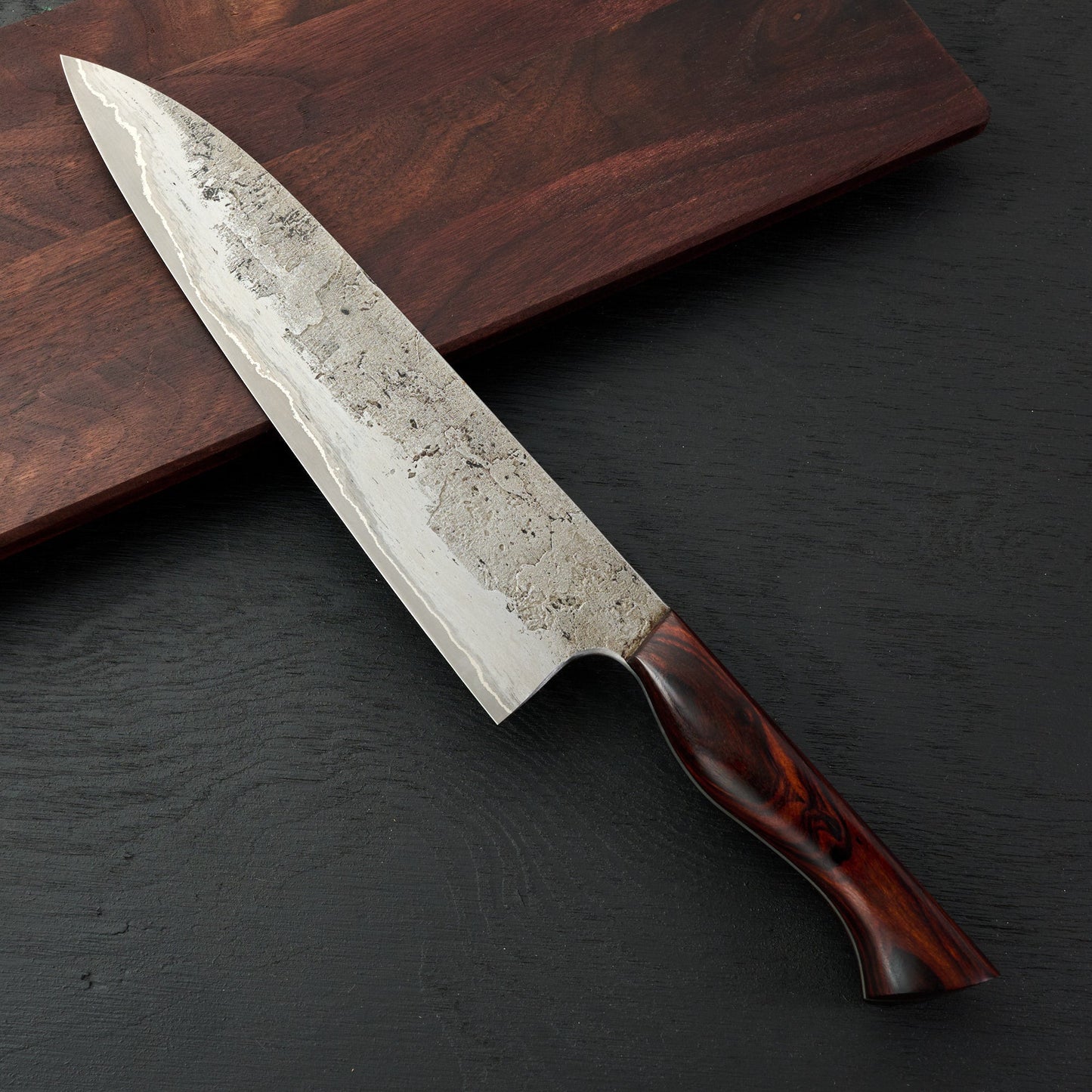
Gyuto 232mm GoMai Full Tang Ironwood

Gyuto 232mm GoMai Full Tang Ironwood

By Brook Turner


No longer available

Brook Turner

Reserve your place

We'll only email you when there's something to say. Invitations go out in signup order as new work becomes available.

For most, buying a kitchen knife means buying a tool that will perform the task of cutting and essentially be there to help prepare meals. At Modern Cooking we look beyond tool and consider the pleasure a kitchen knife can bring to its owner. Consider the difference between a Toyota Corolla and a Porsche 911 and you find the difference between a typical kitchen knife and the knives we offer.

The work of Brook Turner completely embodies this idea. We are not just talking about fancy, exotic materials, but Brook brings those. We are not just talking about premium steels, but Brook brings those. We are not just talking about incredible design, but Brook brings that.

What happens when you close your eyes and you have the face of your knife against your knuckles and it moves effortlessly through the produce you are trying to cut, here we are talking about the hidden sensation that high performance kitchen knives bring, and Brook also brings that.

The music is playing, and you are cooking something delicious, you have your favourite knife in hand and it’s like an extension of your body. At Modern Cooking you will find kitchen knives that are a thrill to use, feature iconic style and make you want to get into the kitchen and just cook.

Ironwood, ergonomically shaped for comfort, tapered tang and cutting geometry for performance, balance, and weight. A cutting edge, that effortlessly moves through produce, forged in premium Swedish “Spicy White” 26C3 steel and clad in beautiful wrought iron for a stunning, rustic finish that is absolutely timeless.

We are laying it on a bit thick, but if you love to cook you probably know what we are talking about. If that is the case, you will love this knife from Brook Turner. 

Product Specification
  • Blade Type:
  • Edge Length: 232mm
  • Spine Heel: 3.02mm
  • Spine Mid: 2mm
  • Spine Tip (20mm before): 1.2mm
  • Blade Height: 53.23mm
  • Weight: 212g
  • Cutting Edge Steel:
  • Steel class: Carbon
  • HRC: 65
  • Blade Construction:
  • Blade Finish: Satin Polish, Brut de Forge, Acid Etched (Forced Patina)
  • Grind:
  • Handle Construction:
  • Handle Materials: Ironwood
  • Handedness: Ambidextrous

Blade type

Gyuto

牛刀

The gyuto is the Japanese interpretation of the western chef knife, and the most versatile blade in a modern kitchen. It carries a long edge, most often 210 to 270 mm, that runs flatter through the heel than its western counterpart before rising in a gentle, late curve to a fine point — a line that favours push- and pull-cutting while still allowing a rocking motion when the work calls for it. There is enough height at the heel to keep knuckles clear of the board, and the tip is fine enough for detail work, which is why most cooks reach for it first.

The flatter edge is the defining characteristic and the trade-off both. More of the blade lands on the board at once, which suits push cutting and gives clean, decisive contact through an ingredient, but a cook who works primarily by rocking will find less curve to work with than a western profile offers. Modern makers increasingly blur the line between the two, drawing a profile that rocks and push-cuts equally well — Birch & Bevel's Modern Gyuto profile, Antoine Kniamen's Western Gyuto, and Benjamin Kamon's own gyuto profile are all examples of that hybrid thinking.

View full knife type guide →

Cutting edge steel

26C3

High-carbon, low-alloy fine-grain steel

Typical HRC
63–67
Corrosion class
Carbon
Production
Conventional
Origin
Sweden (Sandvik / Alleima)

26C3 is one of the most quietly important kitchen knife steels of the past decade. Originally engineered by Sandvik as a razor steel — its lineage runs straight to UHB-20C — it carries about 1.25 to 1.30 percent carbon, very low manganese and sulphur, and a small chromium addition to control grain size. The result is a steel that hardens cleanly into the mid-sixties HRC while retaining genuinely useful toughness for its hardness, an unusual combination outside the powder-metallurgy world.

For the cook, 26C3 sharpens the way the best Japanese white papers sharpen — a quick burr that wipes off cleanly, and a polished edge that holds a screaming apex without microchipping. Toughness at 64 HRC is comparable to or better than 52100 at the same hardness in published testing, which is part of why the Larrin-Thomas-and-friends generation of makers gravitated to it; it lets you grind thinner without paying for it later. Like all clean carbons, it patinas willingly and benefits from a wipe between tasks.

26C3 has become something of a default among UK and European bladesmiths who want a no-compromise carbon edge, and it is the chemical parent of SheffCut, which adds a sliver of niobium to refine grain further. Among the makers Modern Cooking carries, Birch & Bevel, Karol Karyś, Jonas Johnsson, Tobias Heldqvist, Brook Turner, and Fredrik Spåre work in 26C3. It is one of the few non-stainless steels you can recommend to a cook coming from VG-10 without apology.

View full steel guide →

Blade construction

Laminated Steel

A category covering knives built from multiple layers of different steels forge-welded together. The hard cutting steel is sandwiched between softer outer layers (cladding) that protect the core, add toughness, and often contribute visual contrast.

The most common laminated constructions in the Modern Cooking catalogue are:

SanMai (三枚) — three layers: hard cutting steel in the centre, softer cladding on both sides. The traditional and most common form.

GoMai (五枚) — five layers: a hard core, two intermediate layers, and two outer layers. Adds visual depth and structural complexity.

KuMai (九枚) — nine layers: similar logic, with more cladding layers for additional pattern and structural variation.

GoMai and KuMai are often chosen not only for the additional layers and visual depth, but also because the intermediate layers can act as a nickel diffusion barrier — limiting carbon migration out of the core into the cladding during forge welding, and protecting the core's intended carbon content through the heat of the forging process.

In all cases the cutting performance is determined by the core steel; the outer layers are cosmetic and structural. The lamination contributes corrosion protection (when a stainless jacket clads a carbon core), reduced reactivity, and the visible boundary between core and cladding that gives the knife its character.

View full construction guide →

Grind

Convex

A grind whose faces curve outward in a continuous arc rather than falling in a straight line. The practical consequence is that it has no shoulder — no abrupt step where a bevel meets the blade face. Food release improves for the same reason: a curved face touches the cut surface along a narrow band instead of a full flat plane, so slices break away rather than clinging. Drag behaves differently too. A convex blade carries more steel than a flat grind of the same spine thickness, so it is not the lowest-drag geometry available, but the resistance it does create builds smoothly through the cut instead of arriving all at once as the food meets a bevel transition. The feel is progressive rather than sudden.

The curve also supports the edge. Steel thickens quickly behind the apex, which raises edge stability at a given sharpening angle — the apex is less prone to rolling or chipping under lateral load. How much of that you get depends on where the convexity sits. A face can be curved the whole way from spine to edge, or the curve can be confined to the last millimetre or two as a convex "appleseed" edge on an otherwise flat blade. The first shapes how the knife moves through food; the second is felt almost entirely at the edge.

View full grind guide →

Handle construction

Full Tang

A construction in which the blade steel runs the full length and width of the handle, forming a flat core between two handle scales. The scales are fixed to either face of the tang with pins, rivets, or adhesive, and the tang's outline stays visible as a strip of steel around the top, bottom, and butt of the handle — often with the pin heads showing as a row down each side. It is the dominant construction in Western kitchen and outdoor knives.

Because the steel continues all the way to the butt, the handle is essentially the tang dressed in two scales, and the grip is ground and shaped from that sandwiched assembly as a whole. The extra steel carries weight and balance back toward the hand, giving the solid, blade-and-handle-as-one feel that defines the style, and it leaves the edge of the tang on show as part of the knife's line.

View full construction guide →

Shipping & Returns

Shipping

We process orders 5 days a week (Monday - Friday) and ship from our shop in Sydney, Australia. We ship with FedEx, UPS and DHL.

We are happy to offer free international shipping on a variety of orders depending on location and order value.

Free Shipping Regions and Minimum Order Values

For Australia and New Zealand the minimum is $500AUD. For the rest of the world it is approximately €1000EUR. The discount is applied automatically when you reach the minimum cart value at checkout.

Returns

If you're not entirely happy with your purchase, you can return it within 14 days of delivery for a refund. The item must be in its original condition with all original packaging.

  • Returns are accepted for 14 days
  • The customer is responsible for return shipping costs
  • A 15% restocking fee may be applied to change-of-mind returns
  • We do not accept returns on second-hand items for change of mind

Faulty or Damaged Items

You must notify us within 5 business days of receiving your order. Photographic evidence of damage is required. Once approved, Modern Cooking will cover return shipping costs.

Product Care

Cleaning: Clean by hand with warm water. Avoid wetting the handle when possible.

Sharpening: We advise using whetstones to sharpen your knives and a honing rod or steel to maintain the burr between sharpening sessions.

Reactive Steels: Reactive steels like Aogami Super, Apex Ultra or premium reactive German and Swedish steels are susceptible to rust if not properly cared for. Keep the knife dry between uses and when storing for longer periods, wiping the blade with Tsubaki oil or another food-safe oil is a wise choice. A patina can be a beautiful personal feature on your knife and helps to stop rust forming.

Handle Care: For non-stabilised wooden handles, apply Tsubaki oil or another food-safe oil from time to time. Food-safe wax can be applied to both stabilised and non-stabilised wooden handles. Never apply hot wax or oil as you risk warping or damaging the handle.

View full details